Posts

Paper and Slides Available for "Virtuoso: Narrowing the Semantic Gap in Virtual Machine Introspection"

I've recently returned from Oakland, CA, where the 2 5 IEEE Symposium on Security and Privacy was held. There were a lot of excellent talks, and it was great to catch up with others in the security community. Now that the conference is over, I'm happy to release the paper and slides of our work, "Virtuoso: Narrowing the Semantic Gap in Virtual Machine Introspection", which I have described in an earlier post . The slides contain some animations, and so I've made them available in three formats: Keynote (iWork 2009) PDF PDF with notes You can also get a copy of the full paper here . I'm also hoping to have the source ready for release soon; when it is available, you'll be able to find it on Google Code under the name Virtuoso . Once again, thanks to my most excellent co-authors at MIT Lincoln Labs and Georgia Tech for helping me see this project through!

Applying Forensic Tools to Virtual Machine Introspection

I've just released a technical report summarizing some work I did a couple years ago that explores how forensic memory analysis and virtual machine introspection are closely linked. Abstract : Virtual machine introspection (VMI) has formed the basis of a number of novel approaches to security in recent years. Although the isolation provided by a virtualized environment provides improved security, software that makes use of VMI must overcome the semantic gap, reconstructing high-level state information from low-level data sources such as physical memory. The digital forensics community has likewise grappled with semantic gap problems in the field of forensic memory analysis (FMA), which seeks to extract forensically relevant information from dumps of physical memory. In this paper, we will show that work done by the forensic community is directly applicable to the VMI problem, and that by providing an interface between the two worlds, the difficulty of developing new virtualization ...

Automatically Generating Memory Forensic Tools

Image
Now that the IEEE Symposium on Security and Privacy program has finally been posted , I can describe some research I've been working on for the past year and a half related to virtual machine introspection (VMI) and memory forensics. A well-known problem with VMI and memory forensics is the semantic gap -- basically, the kind of information you want out of a memory image or a running VM is high level information (what processes are running, what files are open, and so on) but what you get is a big bunch of uninterpreted bytes (i.e., a view of physical memory). Bridging this gap is what tools like Volatility were built to do, and they do it well. However, building a tool like Volatility takes a lot of work and a lot of knowledge about the internals of the operating system you're trying to examine. With operating systems like Windows, which are closed source, this kind of knowledge comes from things like the Windows Internals book, blog posts, and good old fashioned reverse en...

GDI Utilities: Taking Screenshots of Memory Dumps

Image
I've posted about this before ( twice !), but somehow never gotten around to releasing functioning code. Here (click) , for your downloading pleasure, is a set of plugins designed to extract information about on-screen (graphical) windows from Windows XP SP2/3 memory images. This includes: window_list - give a text listing of the window hierarchy, with each window's on-screen coordinates, current style, and its class (Button, Window, etc.). Here's some example output to whet your appetite . screenshot - save a wireframe "screenshot" of the on-screen windows in a memory image. See later in this post for some examples. Requires PIL . wndmon - continuously monitor a memory image and provide an updating view of the on-screen windows. Works best in a live environment, e.g. with XenAccess and PyXa . Requires PyGame . (This is what I used for the video demo ). All three plugins require the distorm disassembly library to work. I had a bit of trouble getting it to wor...

Plugin Post: Robust Process Scanner

Image
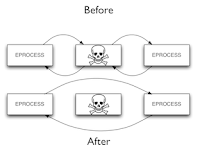
It's pretty well known, in memory forensics circles, that there are two common ways of finding processes in memory images: list-walking , which traverses the kernel's linked list of process data structures, and scanning , which does a sweep over memory, looking for byte patterns that match the data found in a process data structure. Having two different ways of finding processes can be very handy, especially when we suspect that someone may be trying to hide processes. One common way of hiding processes in Windows is called DKOM (Direct Kernel Object Manipulation) ; this technique works by just unlinking the process you want to hide from the kernel's list, like so: This makes it invisible from programs such as the task manager, as well as memory forensic tools that use list-walking (including Volatility's pslist). However, such hidden processes can still be found by scanning memory using a signature for the process data structure; this is what psscan2 does. Unfortunatel...

SANS Forensic Summit: Thoughts and Slides

This past Tuesday I attended the 2009 SANS Forensic Summit. In part, I was there to give a talk on combining volatile memory analysis with forensic analysis (see below for the slides from that), but I was also pretty excited about getting to hang out with the bright lights of the forensics community like Harlan Carvey, Chris Pogue, Richard Bejtlich, and many more. Unfortunately, I was only able to attend the first day, which consisted primarily of technical talks on various aspects of forensics, incident response, and live forensics. All the talks were really excellent; Rob Lee and the folks at SANS should be commended for their great work in putting everything together. In this post I'm going to just describe the talks, rather than the panels; unfortunately I forgot to take notes during the panels and so I don't have as much to say about them, other than that they were fun and highly informative. On to the talks! The first talk of the morning was Richard Bejtlich's keynote...

Odds and Ends

I've been too busy to do any longer entries recently, but I wanted to note a couple things quickly. First up, Andreas Schuster has just released a wonderful set of slides on using Volatility to do memory forensics. The slides include: Great background material on the how, what, and why of memory acquisition and forensics. A refresher on some OS basics you need to really understand memory analysis. An amazing and comprehensive walkthrough on how to use a number of Volatility modules plugins in an investigation (including a few of my own tools, like ssdt.py and VolReg ). Great information on the internals of Volatility, including a tutorial on creating your own plugins. This is really awesome stuff, and I highly recommend it to anyone looking to learn more about Volatility or even start contributing to the community with new plugins! Many thanks to Andreas! Second, I wanted to let everyone know once again that I'm going to be speaking at the SANS WhatWorks Summit in Forensics a...